What Were the Two Primary Subjects of Prehistoric Art
There was a fourth dimension that humans had not nonetheless adult any kind of written language. During this flow, diverse art forms served as a practical method for imparting data between themselves and other tribes. Prehistoric art refers to prehistoric artifacts and art created in the Stone Age, Paleolithic and Neolithic periods.
Tabular array of Contents
- 1 The Definition of Prehistoric Fine art
- i.1 The Origins of Prehistoric Art
- ii Prehistoric Art Around the World
- ii.one Asian Prehistoric Art
- two.ii The Most East Prehistoric Art
- 2.3 European Prehistoric Fine art
- 2.iv African Prehistoric Art
- 2.five Prehistoric Art of the Americas
- three Famous Examples of Prehistoric Art
- 3.1 Blombos Cave
- 3.2 Venus of Willendorf
- 3.iii Lubang Jeriji Saléh
- 3.four Lascaux Cavern Paintings
- 3.five The Chauvet-Pont-d'Arc Cave
- 3.half-dozen Göbekli Tepe
- iv Oftentimes Asked Questions
- 4.i What Is Prehistoric Fine art?
- 4.ii What Techniques and Methods Were Used in Early Prehistory Fine art?
The Definition of Prehistoric Art
Prehistoric art could be defined equally art that was created by people in an era where any form of written linguistic communication had yet not been adult. The fourth dimension in which various cultures throughout homo history started developing their unique language systems varies greatly from region to region.
Before leaving historians a written record of daily events, prehistoric artists left a treasure trove of information backside through their prehistoric artifacts and prehistoric drawings.
Prehistoric artists recorded their daily experiences in mediums that have managed to make it through centuries of harsh exposure to changing environmental conditions, giving united states of america detailed insights into what life was similar in the primeval days of our species before the development of a written grade of communication.
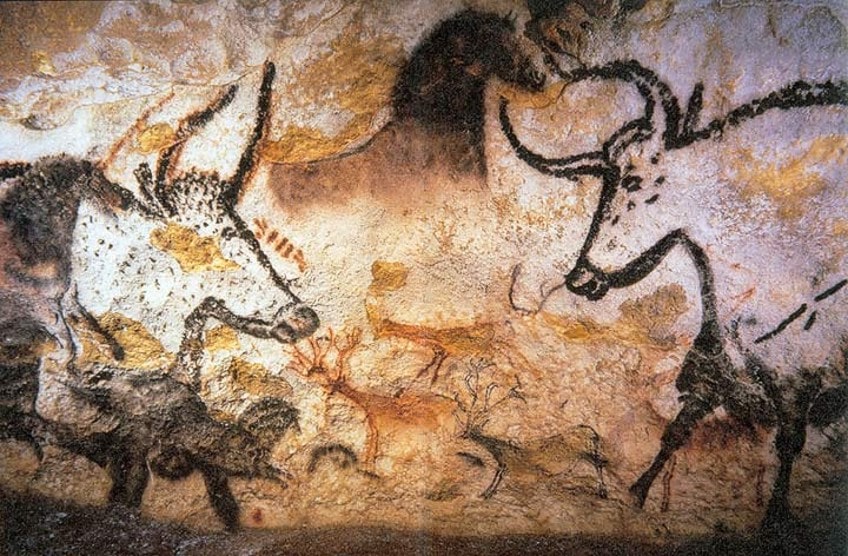 Aurochs, Horses and Deer cave paintings from the Lascaux caves (Montignac, Dordogne, France); Lascaux, Public domain, via Wikimedia Eatables
The Origins of Prehistoric Art
Around 500 000 years ago, one of our early ancestors took a shark's tooth and engraved a zig-zag pattern on the surface of a seashell. Although the reason for its creation is unknown, it is considered to be the primeval existing instance of art. Permit'south look at the various periods during which art kickoff began to emerge in prehistoric art history.
Lower and Eye Paleolithic Era
The engraved shell was said to come from the later on years of the Lower Paleolithic, but most of the evidence points to the Eye Paleolithic as having the best examples of the employ of art for expressive reasons instead of being purely practical in application.
Early hand axes like those found at a site by archeologists at Saint Acheul in France have been shown to incorporate a degree of symmetry and styling that could be evidence of creative expression.
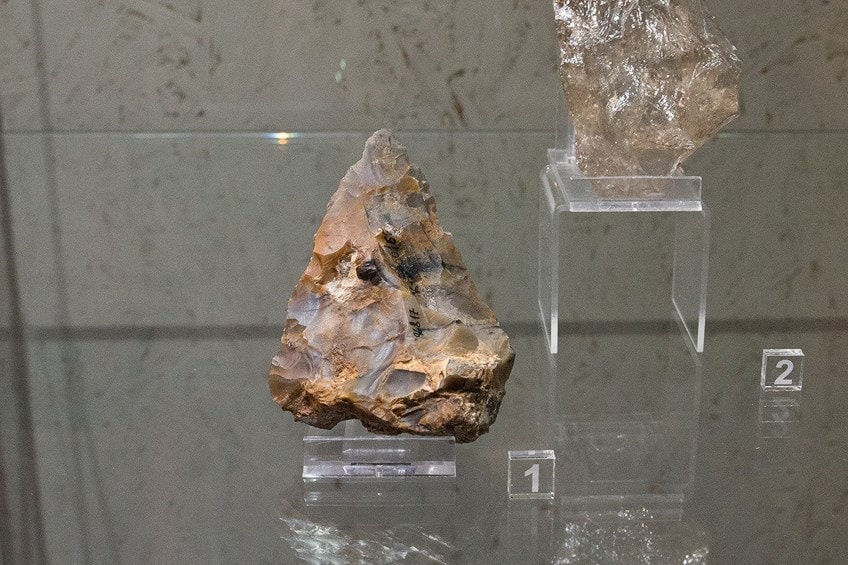 Mitt ax of unique breccia chert. Plant in Kůlna Cave (near Sloup, Blansko District); Zde, CC BY-SA iv.0, via Wikimedia Eatables
Other potential candidates for the earliest examples can be constitute in the Blombos Cave in South Africa and the Venus of Tan-Tan in Morocco. The patterns institute on the walls of the Blombos caves are dated to around 73, 000 years old and are thought to possibly be the earliest existing examples of art fabricated by the human being hand.
Upper Paleolithic
In a cave on the island of Borneo in 2018, scientists discovered what is idea to be the oldest known painting depicting the human form. It has been dated to somewhere between 40, 000 and 52, 000 years of age.
Some of the primeval uncontested examples of figurative prehistoric artifacts were institute in Baden-Württemberg, Germany.
These also engagement to around forty, 000 years ago, the Venus of Hohle Fels being a well-known instance of prehistoric art history from this menstruation. Cave paintings from around forty, 000 to 10, 000 years agone are another source of Upper Paleolithic art depicting figurative forms and motifs, as well equally the sculpture The Venus of Willendorf and several animal carvings, similar the Wolverine pendant of Les Eyzies, which depicts a wolf engraved onto a bone.
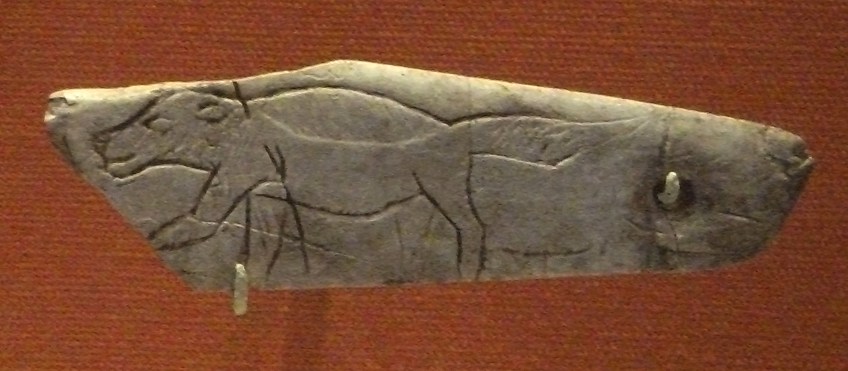 Os pendant decorated with an engraved drawing of a wolverine, Late Magdalenian, around 12,500 years old. Les Eyzies, Dordogne, France;Johnbod, CC BY-SA 3.0, via Wikimedia Commons
Prehistoric Art Around the World
Various cultures around the world adult written languages at different times in human history, and then each region has a unique story regarding its initial development of art. Let's accept a look at how prehistoric art first emerged in various regions across the globe.
Asian Prehistoric Art
The prehistoric art history of Asia is specifically unique considering the written linguistic communication was adopted early on on the continent, especially in China. Mesopotamian art is rarely defined as prehistoric, as written language took roots relatively early in the region, but the surrounding cultures such as the Persian, the Urartu, and Luristan cultures take all had impactful and highly detailed fine art traditions.
In Azerbaijan, dated to be effectually 12, 000 years old, there are approximately 6000 or more rock engravings that represent the figures of humans and animals engaged in various hunting scenarios, which are located at the National Park in Gobustan.
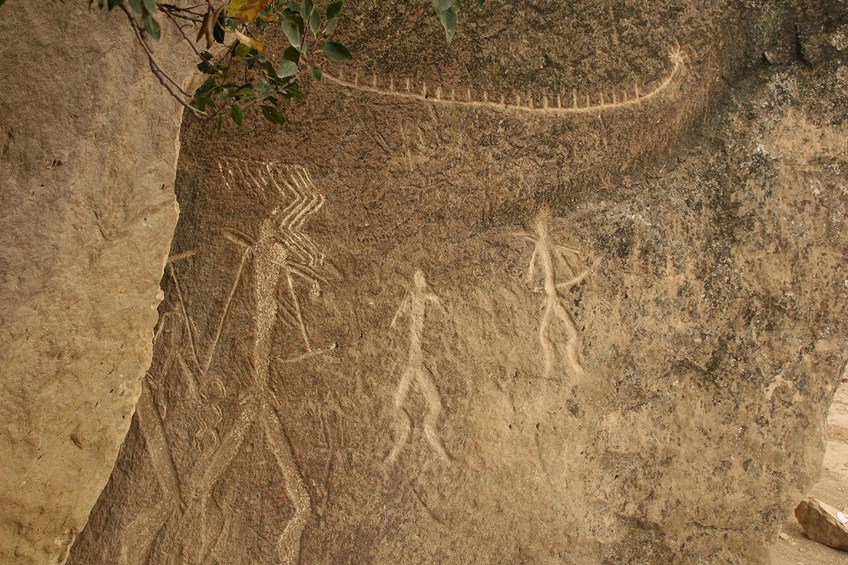 Petroglyphs of Qobustan (Republic of azerbaijan); a UNESCO World Heritage; Walter Callens, CC Past one.0, via Wikimedia Commons
There are besides objects that look similar in design to the Viking Longships. The earliest examples of paintings on the Indian sub-continent are petroglyphs such every bit those establish at the Rock Shelters of Bhimbetka. Petroglyphs are images that are created when a surface such as a cave wall is scraped or picked at until an prototype is revealed.
In China'south Bronze Historic period, the Shang and Zhou Dynasties created many prehistoric artifacts such as bronze objects for ritualistic purposes.
Whereas in Japan, the first people to develop pottery were the ancient Jōmon people, dating to effectually the 11th millennium BC. The Jōmon used sticks or cords (sometimes braided) to create patterns on the wetted dirt figures. In Korea, the get-go examples of art date from somewhere in 3000 BCE, consisting mostly of sculptures likewise every bit petroglyphs according to more recent archeological discoveries.
The Well-nigh East Prehistoric Art
The globe'southward oldest megaliths can be institute at the archeological site of Göbekli Tepe in Turkey. On pillars fabricated during the Pre-Pottery Neolithic phase, i can detect reliefs portraying human and beast figures equally well as abstract patterns. Around the same time in 9000 BCE in Israel, the first known artwork representing ii human figures engaged in intercourse, the Ain Sakhri, was said to have been made in Bethlehem.
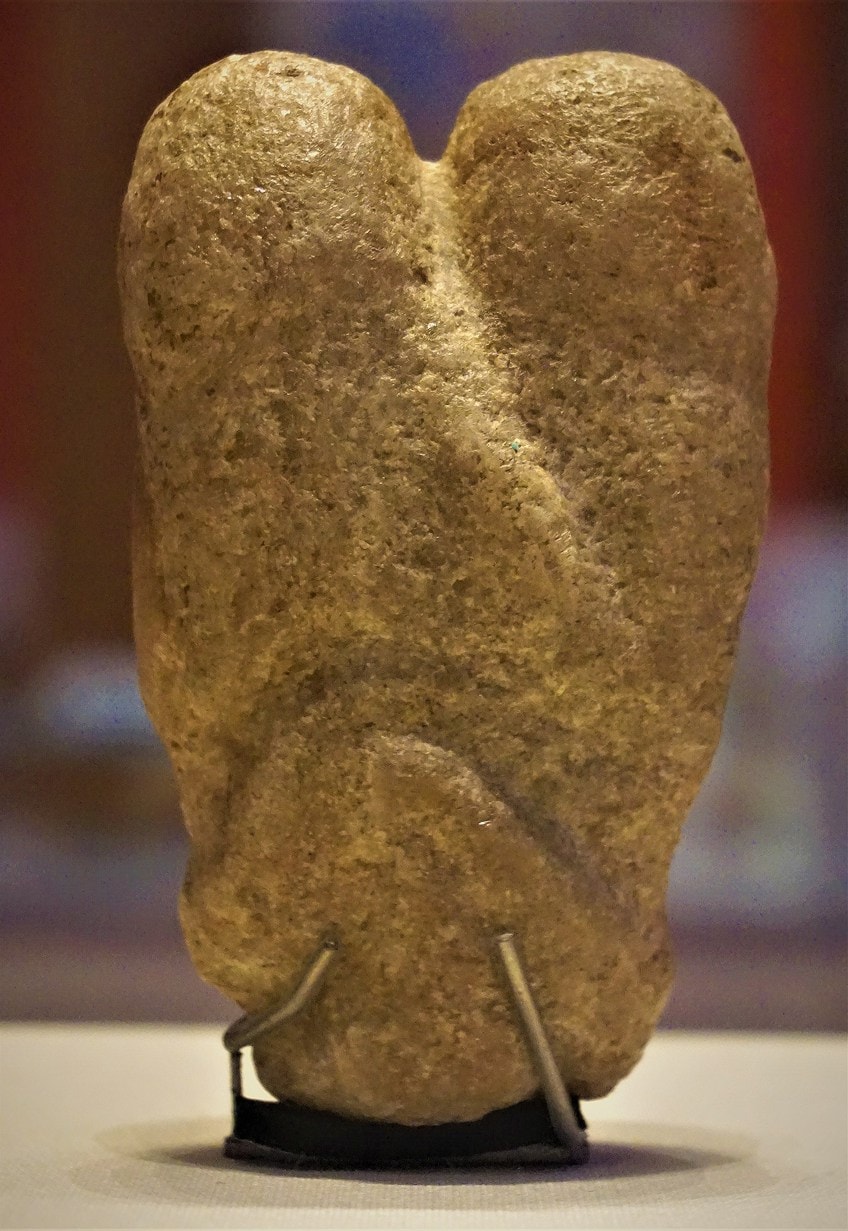 Own Sakhri Lovers;Joyofmuseums, CC BY-SA four.0, via Wikimedia Commons
It is the rise of the Achaemenid Empire that is seen equally beingness the end of the prehistoric era in the Near East in the 6th century, however, writing had already existed for two 1000 years by and so. All the same this unabridged flow is considered prehistoric despite some of the works having text such equally the name of rulers displayed on them.
European Prehistoric Art
During the Stone Age, it was mutual for humans to carve beast figures onto objects such every bit bone or antlers, also as the walls of caves. This was also the period of the Venus figurines. In certain places, simplistic pottery objects besides began being created around this time. This age is divided into the Mesolithic and the Neolithic Age. The Mesolithic Period came afterward the Upper Paleolithic and before the Neolithic Age. In comparison to the other periods, there is little art that has survived from this flow.
The art of the Iberian Mediterranean Bowl, for example, is far less known when compared to like sites from the Upper Paleolithic Flow.
At sites such as Roca dels Moros, the art is generally plant on cliff faces exposed to the open-air environs. Containing the image of 45 figures, the subject field seems to be mainly focused on the human grade rather than animal figures. Figures tin also be seen to exist wearing noticeable garments of clothing and depict daily scenes like nutrient gathering, hunting, engaged in a battle confronting feuding tribes, and dancing.
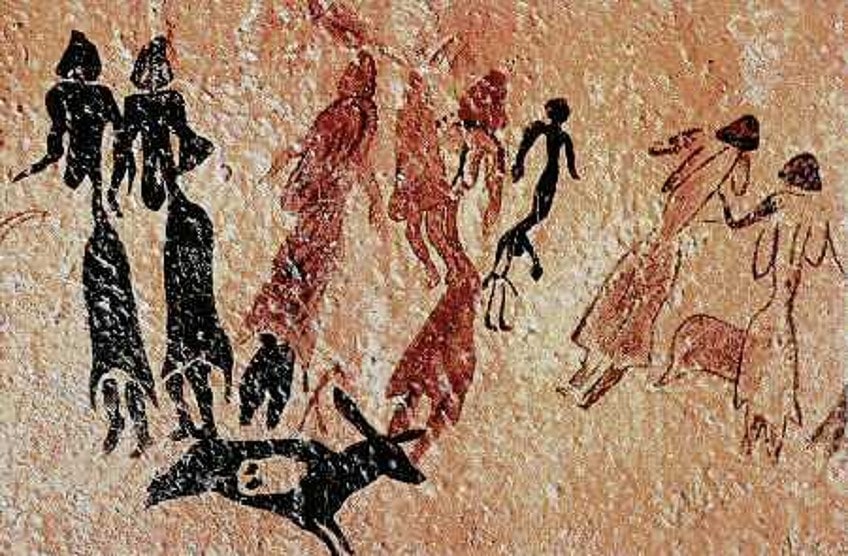 Paintings found at the Roca dels Moros caves; CC BY-SA 3.0, Link
The figures depicted in this era are more energetic in their poses and smaller than their Paleolithic counterparts. Small, simply engraved pendants have besides been discovered from this menses. In the Neolithic Menses, many Fundamental European cultures tended to produce mostly female person statues and very few examples of male figurines, as well as animal figures and detailed pieces of pottery.
Many megalithic monuments were built in this era such as Stonehenge and the Temples of Malta, some of which accept spirals and other patterns carved into the huge stone structures such as the tomb in Republic of ireland which is said to accept been dated from somewhere around 32000 BC.
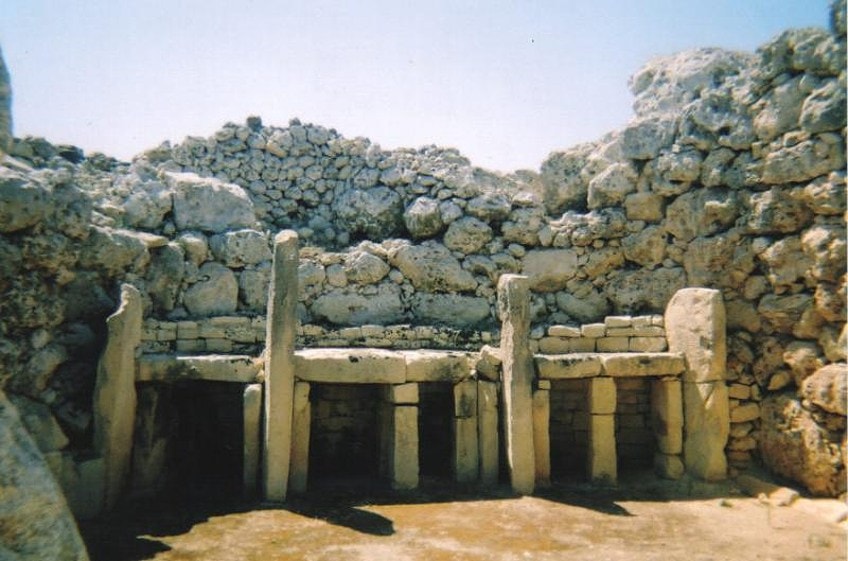 Temples of Malta;Norum at the English-linguistic communication Wikipedia, CC Past-SA 3.0, via Wikimedia Commons
The Bronze Age in Europe saw the rise of new techniques in tool development and this had a great touch on on the quality and speed in which artisans could create works of art.
It is due to the ascension productivity that gild in general began to experience a surplus of luxury items such equally weapons that had been artfully decorated.
During this period nosotros see many fine examples of decorated weapons such as ornamental swords and ax handles, as well as formalism helmets made of bronze. During the following Iron Age, the focus would shift to anthropomorphic sculptures, which attributed human being characteristics to various animals and objects.
African Prehistoric Art
The first known prehistoric drawing created by Homo Erectus was found by archeologists in Southern Africa in September 2018. The prehistoric cartoon is estimated to be approximately 73, 000 years old, which is considerably older than what was previously discovered past almost 43, 000 years. Some rock paintings made past the San people in the Drakensberg surface area are thought to be from the flow 8000 BCE.
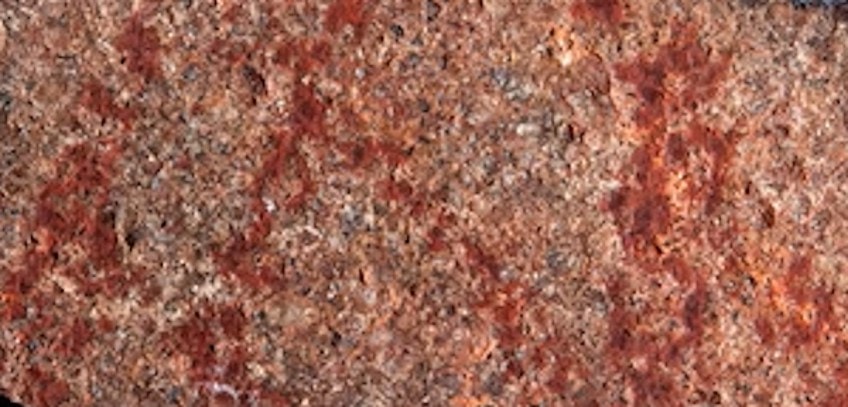 Mayhap the "oldest known drawing past human hands", discovered in Blombos Cavern in S Africa. Estimated to be 73,000 years old; Henshilwood, C.South. et al., Public domain, via Wikimedia Commons
These paintings have remained remarkably clear and portray a multitude of human figures and brute motifs, nigh notably antelope. Withal, not all rock art in the area is idea to be ancient in origin, with a fairly unbroken tradition of painting that has continued until as recently every bit the 19th century, with horses displayed in some paintings, which there were none of in the local environs until introduced at that place by foreigners in the 1820s.
Rock art depicting pastoral scenery can be found at Laas Geel in northwestern Somalia. This germination of caves contains some of the earliest examples of cavern paintings and prehistoric drawings in the region known as the Horn of Africa. They are estimated to have been made sometime between 9000 and 3000 BCE. In 2008, the earliest portrayal of a hunter riding a horse was discovered by archeologists.
It has been dated in the ballpark region of grand to 3000 BCE and was created in the typical Arabian/Ethiopian mode.
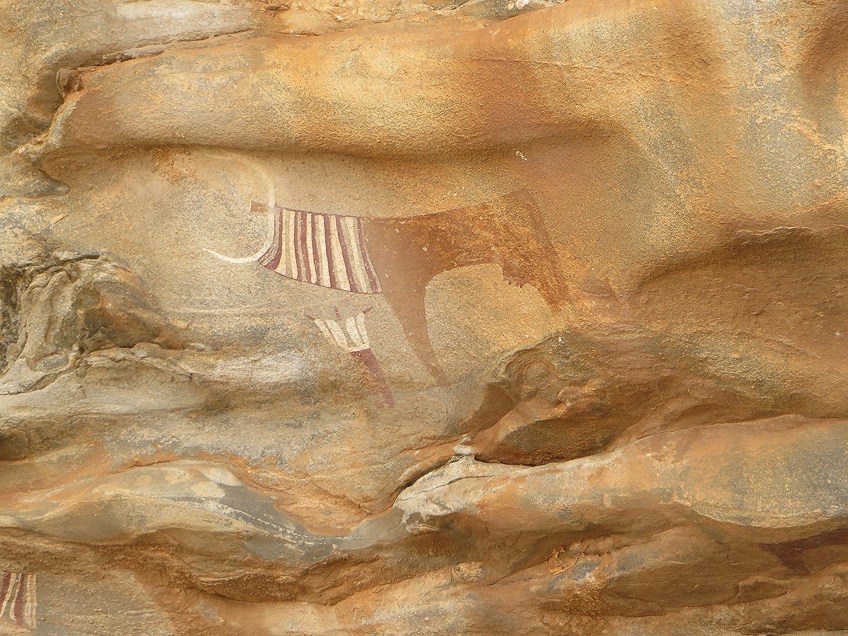 Red and white rock paintings of a stylized cow and a human figure in the caves of Laas Geel; Gerard van de Bruinhorst, CC Past-SA 4.0, via Wikimedia Commons
Saharan Africa had its unique fashion and techniques, with depictions of animate being carved onto walls. Weirdly formed human figures were prominent throughout this menstruation as well as a few animate being depictions. Every bit lifestyles changed for the people towards the end of this menstruum, focus on the subject turned towards the depiction of domesticated animals, every bit well as decorative headdresses and ornate wear.
During this fourth dimension, figures became simplified in blueprint and focussed on common domestic everyday scenes such as the herding of animals and dancing.
Prehistoric Art of the Americas
The Vero Embankment Bome is the oldest known piece of art in the Americas and belongs to the Lithic Period. Dating back to approximately 11, 000 BCE, it is thought to be fabricated of mammoth bone and has been etched with the image of a walking mammoth. In Mesoamerica, we find the Olmec Bird Vessel and Bowl, dated from around m BC and both made from ceramic.
This is noteworthy for its time, equally kilns had to reach temperatures higher up 900 degrees celsius for the ceramics to be produced, and outside of Arab republic of egypt, they were the only known civilization that was able to do then at this time.
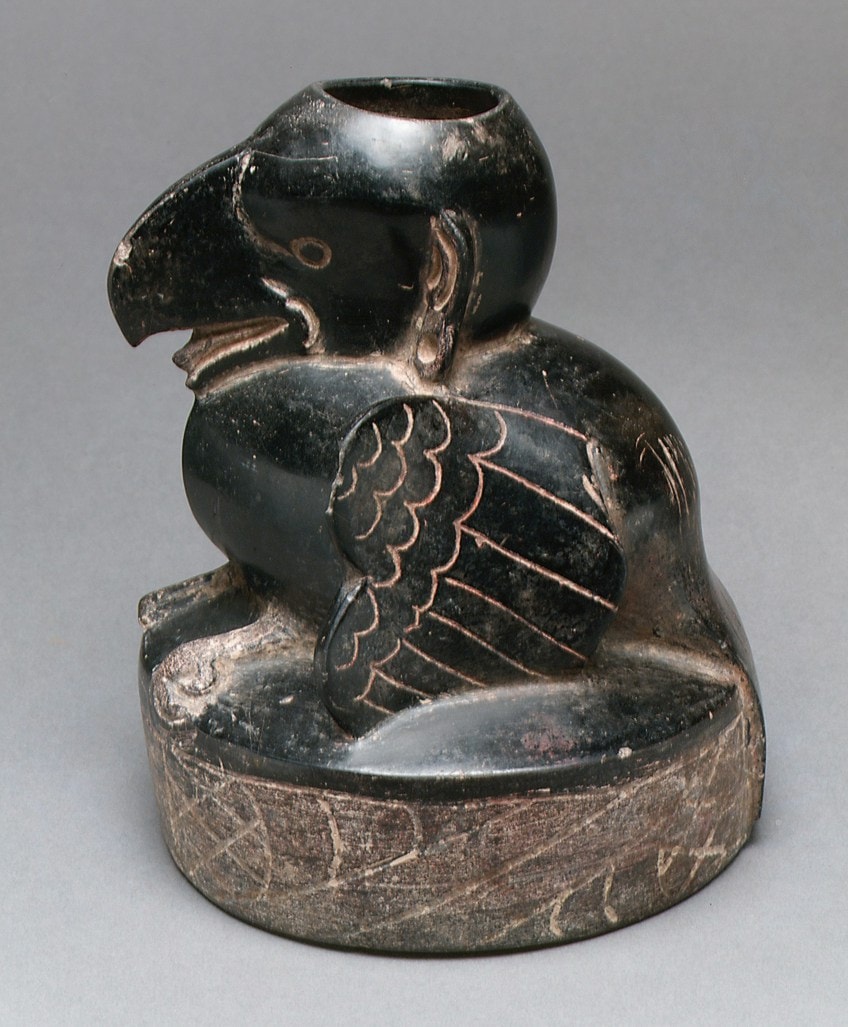 Olmec Bird Vessel, twelfth-9th century BC;Metropolitan Museum of Art, CC0, via Wikimedia Commons
Olmec fine art can easily be recognized past the use of reflective iconography within a religious context equally well as beingness highly stylized. Notwithstanding, despite being stylized, there are also examples of more than naturalistic Olmec art depicting the homo form. Large monumental figurines are abundant in this era every bit well as small carved figures made of jade.
Peru in S America has a long recorded history of man culture dating as far back as 10, 000 BCE. Stone paintings in the Toquepala Caves have been dated every bit far back equally 9500 BCE. Beads have been found at formalism burial sites that are dated to be from somewhere betwixt 8600 and 7200 BCE. Ceramics accept been institute that engagement from effectually 1850 BCE.
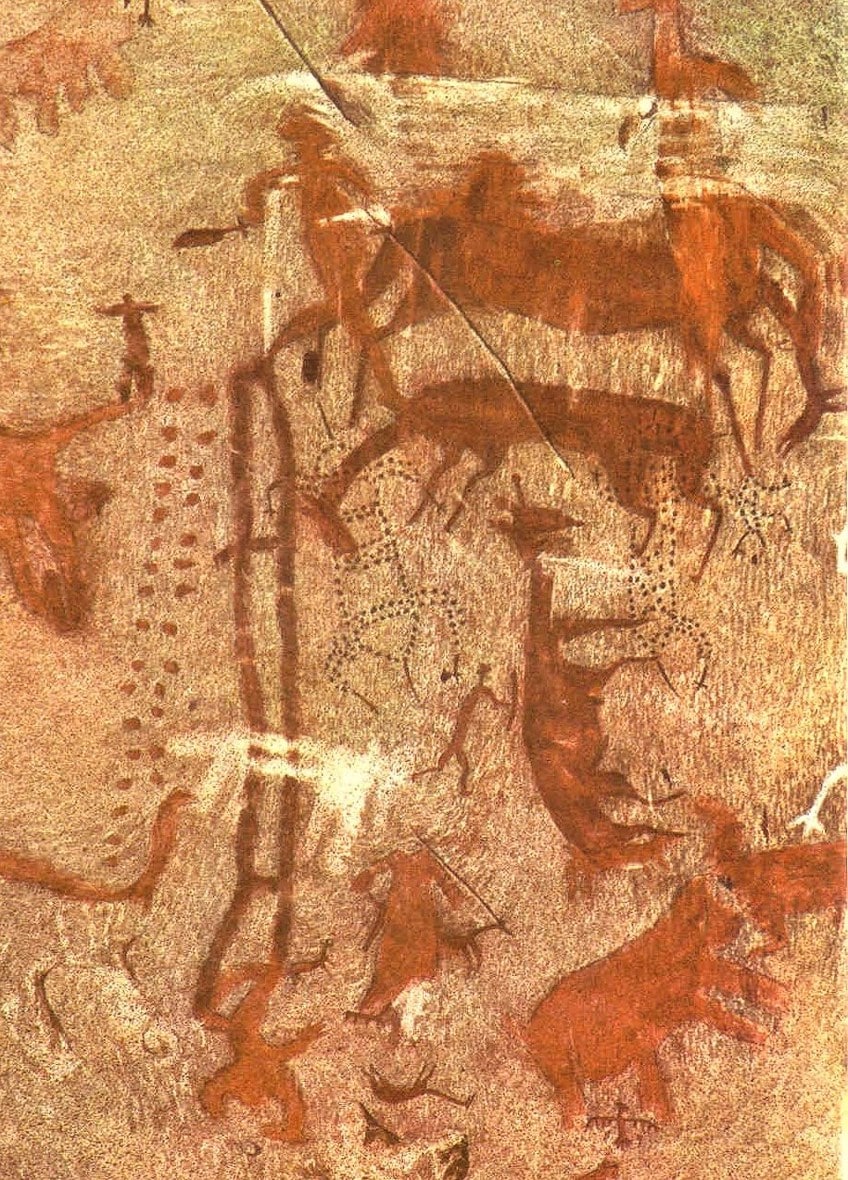 Toquepala Caves painting;Saved from Diomedes Polohttps://tr.pinterest.com/pin/542472717592995389/?lp=truthful, CC BY-SA 4.0, via Wikimedia Commons
The Initial Catamenia for cultures in the Central Andean region lasted approximately somewhere from 1800 BCE to 900 BCE. Textiles from this period display an incredible complexity and included images such equally birds with two heads and crabs with snakes for claws. Depending on how it is viewed, various subjects can seem to dominate the piece of work in some kind of optically created illusion. Artwork that was considered portable at the time included jewelry made of shells and bones, dirt female figures, and mirrors that were highly decorated.
The early Intermediate period is epitomized by work that was extremely enervating of its artist in both time and level of detail required for each slice and used an abundance of visual elements in a vividly colorful manner.
Famous Examples of Prehistoric Art
It is hard enough to enquire the question "what is prehistoric art" without even considering the question "who created the fine art, what was the proper noun of the prehistoric creative person?" These pieces of prehistoric art history were created before written languages had been adult even so, so the chances of united states discovering a signature or proper name seem rather slim to none.
Yet, we have managed to learn much virtually the people who created these artworks as well the techniques they used, and what daily life was like for people in the very distant past.
Blombos Cave
Blombos Cave is situated 300kms from Greatcoat Town in the Blombos Individual Nature Reserve and is considered an extremely important archeological site. It is here that archaeologists found what is now thought to be the oldest known drawing created past human being hands, and is estimated to be near 73, 000 years one-time based on surrounding deposits.
Very little is known about humans from this menses, so information technology comes as a surprise to researchers that humans from this time would display an ability to create works of art.
Researchers hope the find will assist them in gaining insight into our species' first attempts at the use of symbols – a technique of communication and representation that would pave the way for mathematics and the formation of spoken and written languages.
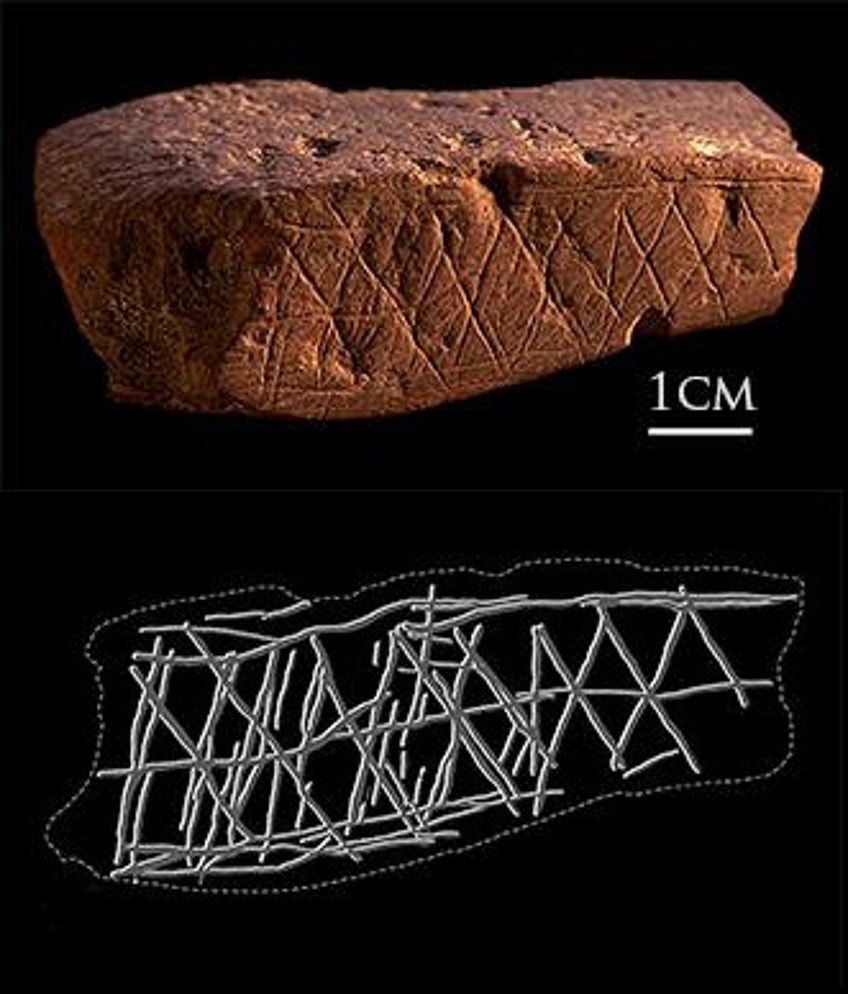 Ochre stone found at the Blombos cave site. The pattern dates from approximately 70,000 years agone;Chris S. Henshilwood, CC BY-SA iv.0, via Wikimedia Commons
One antiquity from this location is a tiny piece of ochre stone, measuring a diameter comparable to the length of a couple of thumbnails. The flake of stone has six singled-out lines fatigued on it as well as three curved diagonal lines running across it. The lines end suddenly, hinting at the possibility that the blueprint extended further beyond the edges of what remains of the bit, in a far more complex manner than initially bachelor to meet from the scrap he found.
There has been much debate on his assertions that it was made by Man Sapiens and intentionally created, and several attempts were made at replicating the potential techniques used by a group of French experts. They analyzed the chemical limerick of the pigments, and subsequently replicating various techniques, it was concluded that the most probable substance used to create the lines was ochre.
Venus of Willendorf
The Venus of Willendorf was discovered in 1908 at the site of Willendorf in Republic of austria by digger Johann Veran during excavations. It has been carved out of oolitic limestone not found in its native region and slightly tinted in pigment made of red ochre. Based on information technology existence made from non-native rock, this sculpture is thought to have been produced somewhere else and then transported to where it was later constitute.
Some believe it was created as some kind of goddess symbol of fertility, a amuse that brings one skilful luck, or even possibly a talisman designed as an aphrodisiac.
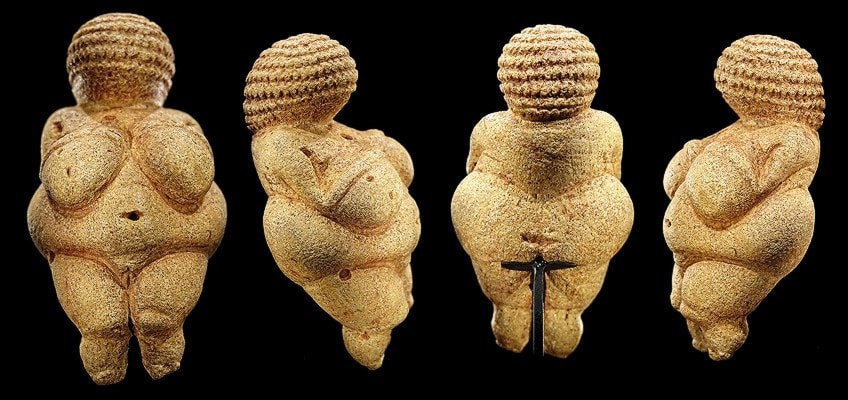 Venus of Willendorf figurine, seen from all four sides; Bjørn Christian Tørrissen, CC BY-SA iv.0, via Wikimedia Commons
The figure consists generally of a female person body and breasts, with the arms present, merely not anatomically represented, they seem understated and shrunk. In that location is a head visible, but 1 that does non show any features except a stylized pattern perhaps meant to represent braided hair or some kind of caput cap.
The anxiety besides seem to exist missing or were perhaps non ever part of the initial design, to begin with. It is believed to be a fertility statue every bit the body parts associated with reproduction seem to be disproportionately exaggerated.
This is 1 of many sculptures from the Paleolithic Menstruum that have been titled "Venus" sculptures even though they profoundly outdated the culture and theology backside the Venus from mythology known by traditional scholars.
There has been some speculation that perhaps the carvings were created by women themselves as a means of self-representation. This was in a time when at that place were no reflective surfaces such every bit mirrors and the proportions of the figurines seem to match up with the associated angle a adult female would see of her own torso if looking downwards at information technology.
Lubang Jeriji Saléh
Borneo island is home to a limestone complex of caves known as the Lubang Jeriji Saléh. At around twoscore, 000 years one-time, it is thought to be one of the oldest figurative paintings known to the world. Located in the East Kalimantan mountains, this series of caves are covered in images of easily that have been made visible through applying flashes of bright orange ochre and fe oxide paint to the walls, spraying the colors over the hand, and leaving an outline of it amongst the burst of colors on cave walls.
These hand outlines have been dated to take been created around 52, 000 years ago. It is amongst these paintings that we also discover the balderdash, thought to be the first figurative painting created by human hands approximately xl, 000 years ago. The illustrated bovine stretches over a rocky canvas measuring more than five feet in length and has been applied to the limestone walls using red ochre paint.
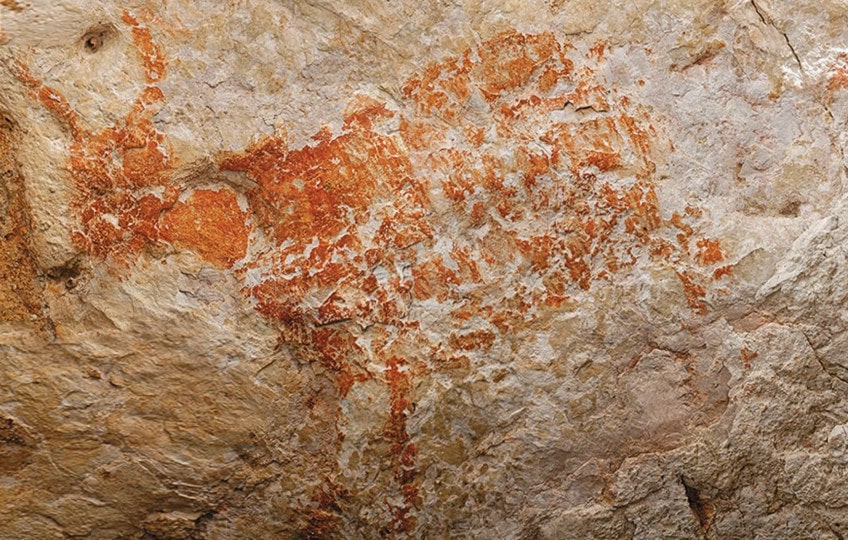 Representation of a wild bovid, the Banteng, made in ochre, discovered in the Lubang Jeriji Saléh cave, E Borneo, Borneo, Indonesia; @ photo Luc-Henri Fage, www.fage.fr., Public domain, via Wikimedia Commons
In 2018, scientists were able to practice a more in-depth analysis of samples taken from the site and ended that the site was decorated in 3 stages over fourth dimension. During the first stage, the hands and balderdash were added. In the second stage, complex motifs were added, using stencils and a mulberry-colored paint mix. During the 3rd and final stage, h2o vessels, designs of geometric patterns, and human-similar figures were added to the cave walls.
The team that led the enquiry of the site in 2018 originally concluded that this was the first known example of a figurative painting by a prehistoric creative person.
Withal, they have since made further discoveries of artworks in caves in Sulawesi that are fifty-fifty older at around 44, 000 years of historic period. This discovery still holds much significance for fine art historians, however, as it shows united states that cavern art gave rise at the aforementioned time in Asia as it did in Europe. Experts hold that the finding is very significant to archeological discovery, withal has little to offering in terms of data on the early on origins of art geographically speaking.
Lascaux Cave Paintings
The Vézère Valley is home to many famously decorated caves that were commencement discovered in the early days of the 20th century. Amid them, i of the almost well-known would be the Lascaux cavern paintings. Renowned for its Paleolithic era cave paintings, the caves are situated in Dordogne, a region of southwestern France. They are most highly revered for the complication of blueprint, outstanding quality of production, historic period, and sheer scale. The paintings are estimated to be in the region of 20, 000 years of age.
A cave complex consisting of several areas, Lascaux was discovered on 12 September 1940 and later that year was honored with historic monument protection condition.
Lascaux caves are part of several cavern complexes in the expanse that were added to the UNESCO list of Earth Heritage Sites, yet they remain in abiding danger of farther deterioration and are the constant source of symposiums for archeologists and scientists to discuss how to handle these artworks to ensure a legacy that spans even further into the future.
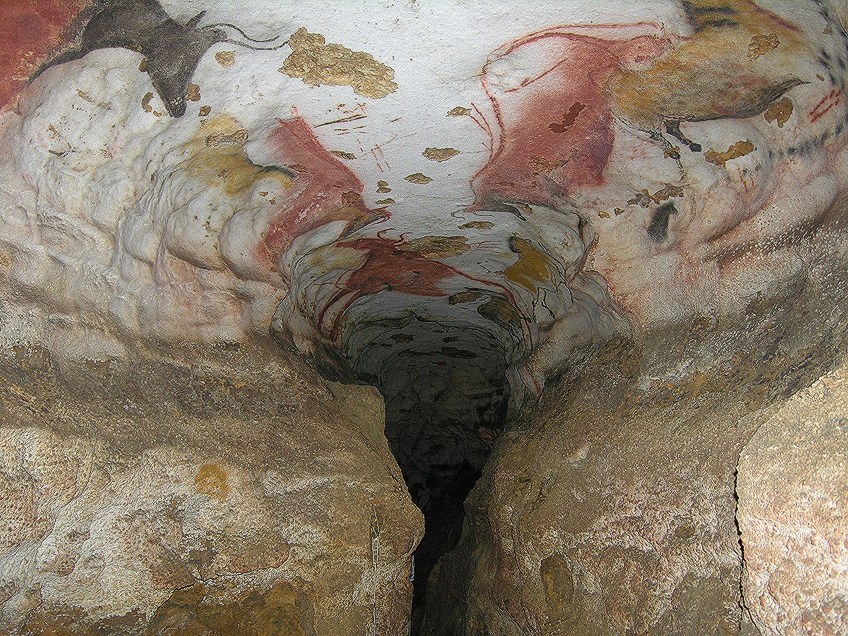 The Great Hall of the Bulls, Lascaux cave, France;Francesco Bandarin, CC BY-SA 3.0 IGO, via Wikimedia Eatables
Archeologists accept identified several distinct sections of the cave circuitous, giving them such titles as The Great Hall of the Bulls, The Chamber of Felines, and The Shaft of the Dead Man. Abstract symbols, animal effigies, and human figures form the three groups that the more than 2000 figures on the cavern walls tin exist divided into.
The majority of these images have been impressed on the wall with painted mineral pigments, although others take been chiseled into the stone's facade.
The paintings in Lascaux caves mainly consist of 364 horse figures, besides equally ninety stags and various other animals such as felines, rhinos, cows, a single deport, bison, and even a human. In the Hall of Bulls, we detect the most well-known image of the cave, the four black bulls, one of which alone is 17 feet in bore, which makes it the largest known painting of an creature in cave art.
The Chauvet-Pont-d'Arc Cave
Archeologists take concluded that the figurative cave paintings in the Chauvet Cave are some of the most well-preserved examples of prehistory art effectually the globe. The cave is situated on a cliff made from limestone in Ardeche, Southeast France, and was showtime discovered on 18th December 1994.
It is considered past many art historians and archeologists to be an extremely important prehistoric site, with UNESCO granting the cave'due south World Heritage status in 2014.
Various groups of researchers take gathered pregnant data and agreement of the civilization that may have created it over the years. Non only were paintings discovered past archeologists, only likewise the fossil remnants and markings of animals, many of which no longer exist today.
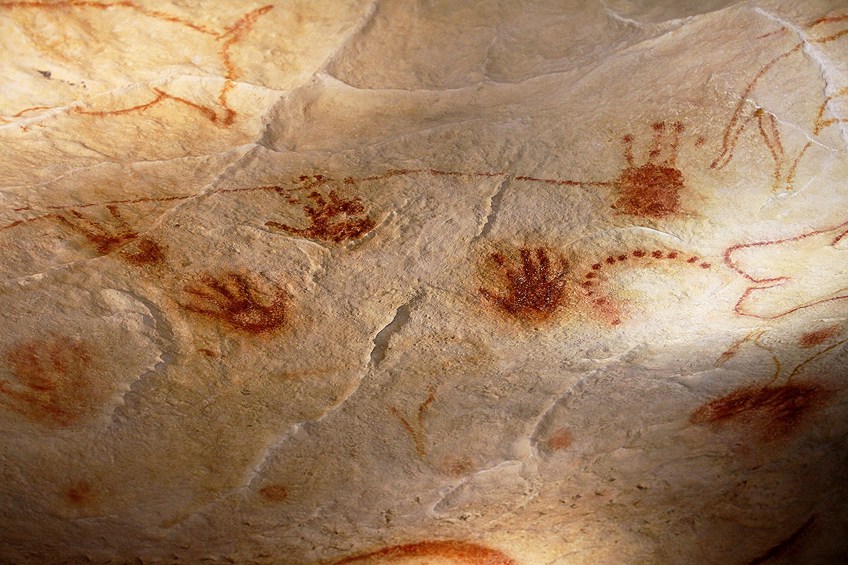 Positive hands (including a trace of a curved little finger: this character is constitute in various places in the cave), enigmatic signs, and cerise and xanthous drawings at the Pont d'Arc cave (copy of the Chauvet Cave);Claude Valette, CC Past-SA iv.0, via Wikimedia Commons
Contempo carbon dating studies have isolated two periods in which the caves were habituated by humans, a period from 37, 000 to 33, 500 years ago and some other period following that from 31,000 to effectually 28,000 years ago.
All that remains from the latter menses are the prints of a child's foot, the sooty remnants of the community fireplace, and blackened stains on the cavern walls from the use of torches.
The child's footprints could be the oldest prints of the human human foot that tin accurately exist dated, as, later the visitation of the child who made the prints, the cave remained untouched until its rediscovery in 1994 due to a landslide or something similar.
Göbekli Tepe
Göbekli Tepe is situated in Southeastern Anatolia in Turkey and is considered by historians to be a site of significance for man civilization and the development of culture and art. The Mesolithic age mound is a prime number instance of megalithic art. Göbekli Tepe was formed past ane settlement built upon another settlement in the same place over time, the debris and remnants from the former settlements stacking up over the decades to create a mound that exceeds fifteen meters in height and effectually 300 meters in bore.
The multi-layered complex has been carbon-dated to around 9559 BCE and it is said to incorporate the oldest stone structures bearing artwork engraved upon it.
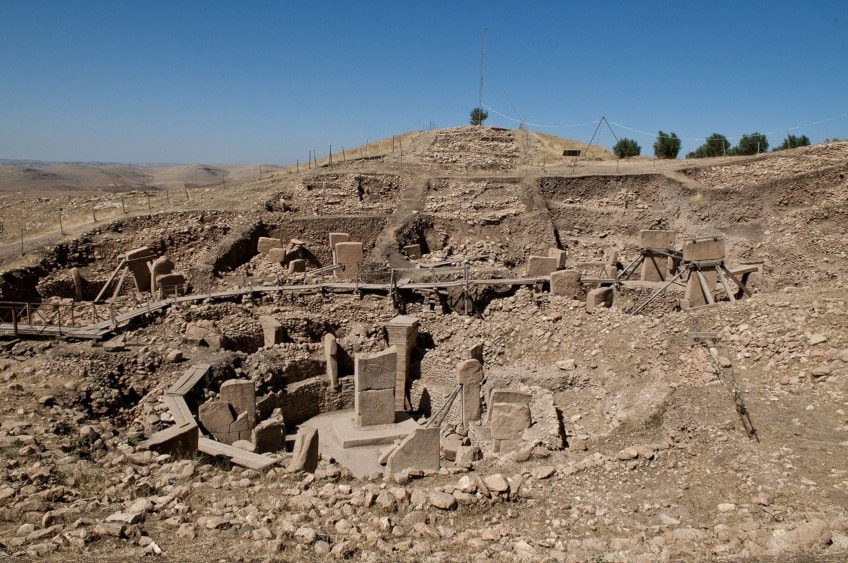 Göbekli Tepe, Şanlıurf;Teomancimit, CC By-SA 3.0, via Wikimedia Commons
The almost common motifs were the depiction of various animals such as boars, bulls, foxes, and lions. Only a few examples of imagery depicting the human figure have been found at this item site, a notable exception existence the relief of a naked female crouching downwards on the basis. The true purpose of this site remains shrouded in mystery, just the archeologist Klaus Schmidt has suggested that the site was most likely used equally a cult center or holy place during the Neolithic menstruum. This is largely evident by the unusual number of megaliths that were used in the construction of the layout of the site.
In summary, we have learned that prehistoric fine art predates the use of written language by various cultures throughout human history. We accept also seen how the period of transformation for each civilisation to one based on written text differs from region to region. At that place are examples of early on cave art that appear simultaneously in both Asia and Europe.
Frequently Asked Questions
What Is Prehistoric Fine art?
Prehistoric fine art refers to all art that was created before cultures had developed more complex forms of expression and communication such as a written language. Prehistoric art tin can not only be described as fine art found on cave walls, just also prehistoric sculpture such equally the Venus figurines. Some of the earliest examples of prehistoric art in civilized communities are the huge monoliths found in ancient sites such every bit Gobekli Tepe and many others.
What Techniques and Methods Were Used in Early Prehistory Fine art?
As with whatever era, artists that created prehistory fine art were limited past the resources available to them at the time they lived. The very first fine art was made from tools and canvases readily accessible to them such every bit cave walls, bones, and pigments such every bit ochre and burnt wood. Not only did they use various pigments to pigment on surfaces, but also carved images on os, stone, and walls, likewise every bit made various pieces of clay sculpture and pottery from available materials in the region.
cottinghamrouresing83.blogspot.com
Source: https://artincontext.org/prehistoric-art/
0 Response to "What Were the Two Primary Subjects of Prehistoric Art"
Post a Comment